
Attic Insulation Whitby
A warmer upstairs, fewer ice dams and a furnace that doesn’t have to work as hard, topped up by the roofers already looking after your attic.
Prefer to type it out? Request your free attic check here.
Blown-in fibreglass top-ups from the in-house crews who already look after Whitby roofs.
- Rated Excellent on Google
- Family-run since 1994
- 10-year workmanship warranty
- $5M insured · WSIB cleared
- Up to $1,500 back with a home energy assessment
On almost every roof quote we give in Whitby, the conversation ends up in the attic. Is there enough insulation up there? Is that why the back bedroom never warms up, or why ice builds up along the gutters every February? Often the answer is yes, and now our own crews take care of it.
Lift the attic hatch in an older Whitby house and the problem is usually easy to see: batts pressed flat over the years, the tops of the ceiling joists showing through, and insulation pushed into the eaves where it blocks the soffit vents. Each of those costs you something. Heat leaks out through the ceiling all winter and the furnace runs longer to make up for it. In July, the same thin layer lets a sun-baked attic heat the rooms underneath.
C.D. Roofing & Construction has worked on roofs across Whitby and Durham Region since 1994, and on most houses the attic is simply the underside of the roof we’re looking after. We top up attic insulation with blown-in fibreglass, seal the air leaks that carry warm, damp air up from the house, and keep the roof’s ventilation working while we do it. Insulation is one part of what we do on Whitby houses. The rest, from re-roofing to repairs, is on our Whitby roofing page.
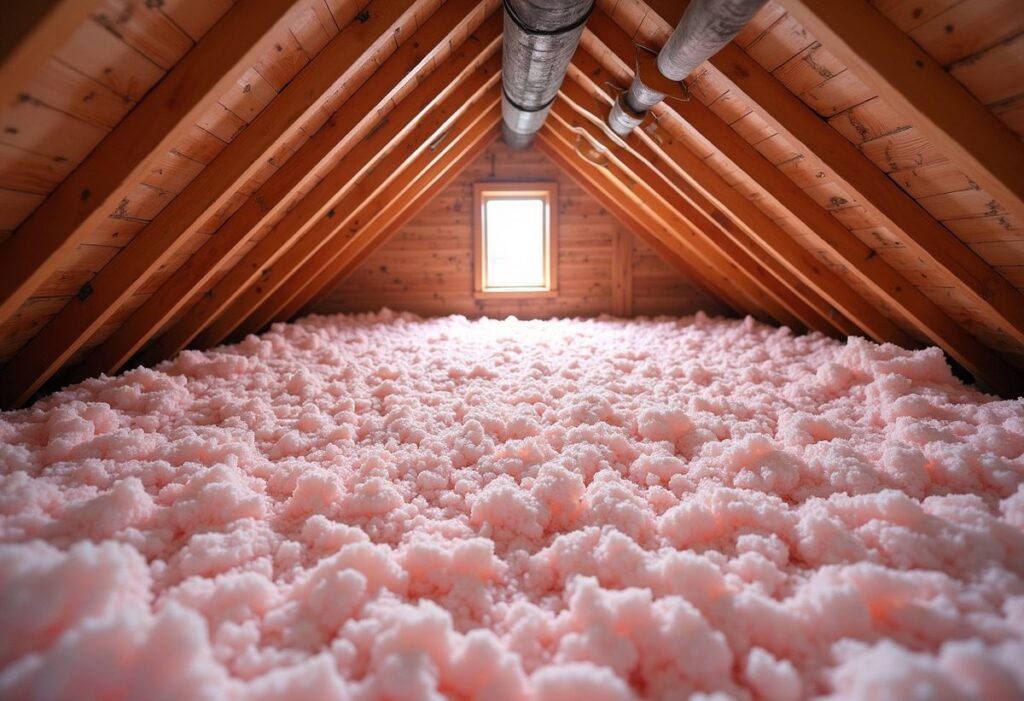
What a Thin Attic Looks Like From Inside the House
You don’t have to climb up there to suspect a problem. The house usually drops hints first.
- Ice along the eaves.
Heat escaping into the attic melts snow on the upper roof, and the water refreezes over the cold overhang. If you’ve needed ice dam removal more than one winter running, the lasting fix is above your ceiling.
- Snow that vanishes from your roof first.
After a snowfall, compare your roof with the neighbours’. If yours has bare patches while theirs stays white, heat is getting through.
- An upstairs that’s never comfortable.
Chilly bedrooms in January, stuffy ones in July, while the thermostat downstairs says everything’s fine.
- Joists you can see.
If the tops of the ceiling joists show above the insulation when you look through the hatch, there’s far less up there than a modern house should have.
- Frost or dark staining on the underside of the roof deck.
Frost is moisture from the house reaching cold wood, which usually means air is leaking up through the ceiling. Dark stains can come from the same thing or from a roof leak, and either way it’s worth a look.
One of these on its own doesn’t prove much. Two or three together usually point to the attic, and one look up there settles it.
Recognize a couple of these at your place? We’ll take a look up there and tell you what’s going on.
Why Whitby Homeowners Trust Us Above Their Ceiling
- 1994Family-run since Chris Delaney started the company
- 10 yearsWorkmanship warranty, insulation included
- $5MLiability insurance on every job
- WSIBClearance certificates on request
- All crewCertified in Working at Heights
- BP PlatinumCertified roofing installer


Insulation Planned From the Roof Down
It’s easy to treat an attic as a floor that needs covering. We treat it as part of the roof, because that’s what it is. The insulation on the ceiling, the air moving through the space above it and the wood sheathing under your shingles work as one system, and a change to any of them shows up in the others.
Pile new insulation into the eaves without leaving room for air and you cut off the soffit intake your roof vents rely on. Leave gaps in the ceiling and warm, moist air from the house keeps drifting upward, condensing on cold sheathing and feeding mould. Get both right and the attic stays cold and dry through the winter, which is exactly what a roof deck wants.
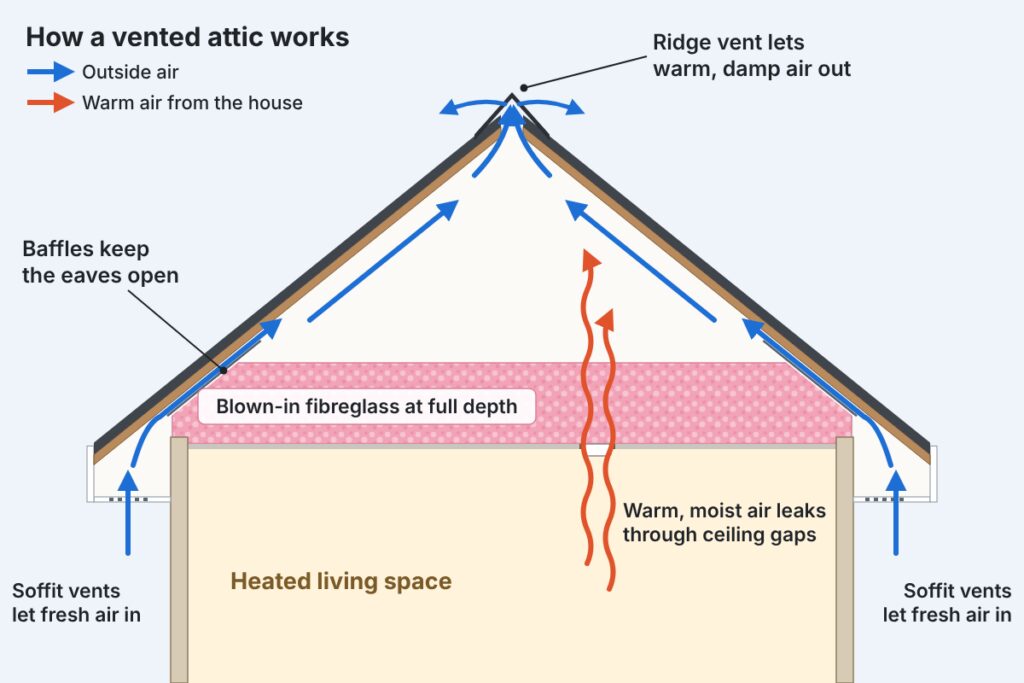
That’s why we look at the insulation and the attic ventilation together and keep the airflow path open at every eave. When something on the roof itself needs attention, the company that spotted it is the one that can fix it. Insulation contractors and roofers are usually separate trades. Here, the crew blowing in the new layer works from the same plan as the people who know your roof.
The people working above your ceiling are C.D. employees, not subcontractors, and several of them did attic insulation work before they joined us. Founded by Chris Delaney in 1994 and co-owned by Ryan Tierney, the company is family-run, carries $5 million in liability insurance and provides WSIB clearance certificates on request.
Insulation work is covered by the same 10-year workmanship warranty as our roofing.
Attic Insulation Top-Ups, Removal and Re-Installs
Most attics we see don’t need to be stripped out. They need more insulation on top of what’s already there, and that’s where most of our jobs start. When the old layer is past saving, we take it out and start fresh.
Blown-In Fibreglass Top-Ups
A top-up means blowing loose-fill fibreglass over the insulation you already have until the attic reaches the depth it should have. Loose fill settles in around joists, wiring and truss webs where batts never fit cleanly, and as long as the old layer underneath is dry and in decent shape, it stays where it is and keeps working.
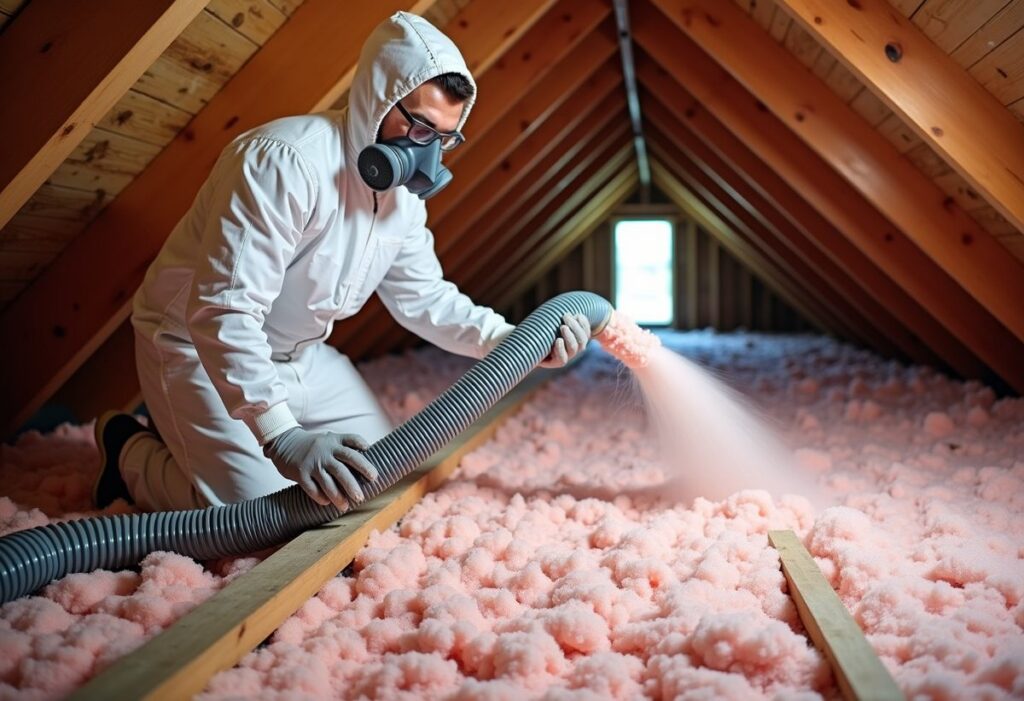
We use fibreglass because it’s the material our crews trust in an attic. It’s inorganic, so it won’t rot or feed mould, it doesn’t soak up water, and it’s light enough that a deep layer doesn’t weigh down the ceiling below.
Removing Wet, Packed-Down or Rodent-Damaged Insulation
Old insulation doesn’t always have to go, but there are good reasons to pull it. Batts soaked by an old roof leak or years of condensation lose much of their value and can hold moisture against the wood. Insulation that’s been crushed flat is doing a fraction of its original job. And where raccoons, squirrels or mice have been living, the droppings and urine they leave behind shouldn’t be buried under a fresh layer. In those cases we vacuum the old material out and install a full new layer of blown-in fibreglass.
If animals in the roof are part of the story, the way in has to be closed off before new insulation goes in, or the new layer just becomes the next nest.
Vermiculite is the exception to every rule here. The loose, pebbly fill found in some older houses, usually silver-gold to grey-brown, may contain asbestos. The Canadian Centre for Occupational Health and Safety advises having it tested before any work and leaving its removal to a qualified asbestos removal professional. If we find it, you’ll hear about it before anything else happens.
Air Sealing and Baffles Come First
Insulation slows heat down, but it doesn’t stop air. Warm air leaking through the ceiling carries moisture with it all the way to the roof deck. So before a top-up starts, we seal the gaps between the living space and the roof space: around plumbing stacks, wiring holes, light fixtures and the hatch itself.
At the eaves we fit baffles, sometimes called rafter vents, in each rafter space. They hold the insulation back from the soffits so outside air can keep flowing in and up under the roof deck, which is the job your soffit vents were put there to do. If the soffits are rotted or were never vented in the first place, that’s a separate repair, and our soffit and fascia repairs take care of it.
Not sure whether a top-up is enough? That’s what our free quotes are for.
Warmer in Winter, Cooler in Summer
Attic insulation is usually sold as a winter fix, and that’s where most of the benefit shows up: less heat escaping through the ceiling means the furnace doesn’t have to run as long to keep the house warm. But insulation works in both directions. On a summer afternoon the attic above you can get much hotter than the air outside, and the same layer that holds heat in through January keeps that heat out of the upstairs bedrooms in July, so the air conditioning doesn’t have to work as hard.
The best time to top up is before the furnace starts running for the season, so every cold month afterwards starts with more insulation overhead. The work is done inside the attic, so it can go ahead in most weather.
Attic Insulation Rebates in Ontario: How to Qualify With Us
Ontario’s Home Renovation Savings Program, run by Enbridge Gas and Save on Energy, has two ways to get money back on attic insulation. Which one you use decides who can do the work.
With a home energy assessment: works with C.D.
Book an assessment with a registered energy advisor before any work starts, complete at least two of the upgrades in your report, then have a follow-up assessment. In this route you choose the contractor, and that can be us.
Without an assessment
A separate attic-only rebate of up to $1,250 is paid only on work by contractors on the program’s pre-approved list. That list isn’t open to new contractors.
Attic insulation rebates in the assessment route, for bringing the attic up to at least R-50:
| Starting level | Rebate |
|---|---|
| R-12 or less | up to $1,500 |
| Above R-12, up to R-25 | up to $1,200 |
| Above R-25, up to R-35 | up to $900 |
Air sealing can add up to $250 if the house meets its air-tightness target. Tell us you’re going for the rebate and we’ll plan the job to reach R-50.
Start by checking your eligibility and booking your assessment through the Home Renovation Savings website.
Amounts as published by the Home Renovation Savings Program, checked October 2026. Programs change, so confirm the current rebates before you book.
How an Insulation Top-Up Works: The C.D. Attic Check
Five steps, the same on every house, so you know exactly what happens above your ceiling and why.
We look before we quote. Every job starts with one of our team going up into the attic to check the type and depth of the insulation, any moisture or mould on the sheathing, whether the soffits are open and where the exhaust vents are. We also look for bathroom fans that vent into the attic instead of outdoors, a common source of moisture up there.
You get a plan and a price. We explain what we found, what we’d do about it and what it will cost: a top-up in most cases, a full removal and re-install when the old layer is past saving. If the roof itself needs work, you’ll hear about that too, and if you’re already planning a roof replacement, it often makes sense to sort out the insulation at the same stage.
Prep comes first. Anything wet, mouldy or contaminated comes out (vermiculite excepted, as above), the air leaks get sealed and baffles go in at the eaves.
Then the insulation goes in. Fibreglass is blown evenly across the ceiling, right out to the eaves, to the depth set out in the plan.
A last check before we go. Before we leave, we make sure the eaves are still clear and the hatch closes tight over the new depth.
The first step is the attic check. Book it by phone or online.
What a Top-Up Changes Up There
The difference is easy to see once the hatch is open. Here’s what we usually find before a top-up, and what you’ll see after we’re done.
Before
- Old batts pressed flat, with the tops of the joists showing
- Insulation pushed into the eaves, blocking the soffit vents
- Gaps around light fixtures, stacks and the hatch letting warm, damp air up
- A thin strip of insulation where the roof meets the outside walls
After
- Blown-in fibreglass level across the whole ceiling, at the depth in your plan
- Baffles at every rafter space, so the soffits can keep feeding air under the roof deck
- Air leaks sealed before the new layer went in
- Eaves checked and the hatch closing tight over the new depth
Want to see how our crews work? Browse our recent Whitby and Durham Region projects.
Lake Wind, Old Batts and Brooklin Eaves: What We Find in Whitby Attics
Whitby’s housing runs from older houses around downtown and the original village of Brooklin to the newer subdivisions that have filled in around them, and what we find overhead covers the same range.
Older houses were insulated to the standards of their day, if at all, and decades of settling and the odd roof leak have done the rest. These are the houses most likely to need a full removal, and the ones where we check for vermiculite before anyone touches anything.
Down by the lake, in neighbourhoods like Whitby Shores, wind coming off Lake Ontario pushes through soffit vents and can blow loose insulation back from the eaves, leaving the outer edge of the ceiling bare.
Baffles fitted properly at the eaves keep the insulation where it was installed.
Newer houses, including the newer streets in Brooklin, aren’t automatically in the clear. Where the roof slopes down to meet the outside walls, there’s very little height for insulation, and that strip is often thin, along with the gaps around hatches and light fixtures. Heat lost there warms the roof just above the overhang, which is how ice dams get started, so the eaves get a close look in every house we work on.
Our crews provide the same attic insulation services in Oshawa, Ajax, Pickering, Courtice and across Durham Region.
Attic Insulation Questions We Get Asked
What R-value should my attic have?
R-50 is a sensible target for an attic upgrade in Ontario. A lot of older attics sit far below it, and if you can see the tops of your ceiling joists, yours almost certainly does. When we look at your attic, we’ll tell you roughly where it sits now and how much fibreglass it takes to get there.
Should old insulation come out before new insulation goes in?
Usually not. If what’s there is dry, clean and lying reasonably flat, new loose fill goes right on top and the old layer keeps doing its part. It comes out when it’s wet or mouldy, when animals have been living in it, or when it’s been crushed down so far it isn’t doing much. One caution: if it’s vermiculite, have it tested before anyone disturbs it.
Why do you use fibreglass?
It’s the material our crews trust in an attic. Fibreglass is inorganic, so it won’t rot or feed mould, it doesn’t soak up water, and blown-in fibreglass is light enough to go in deep without weighing on the ceiling. It takes more depth than some materials to reach the same R-value, and we plan every job around that.
Can you top up my attic when you replace my roof?
Yes, and it’s one of the easiest times to do it. We’re already on site, we’ve seen the roof deck and the ventilation, and any repairs to the sheathing are done before the new insulation goes in. Just mention it when we quote the roof.
Can you add insulation without blocking my roof vents?
Yes, and it’s one of the best reasons to have a roofer do the job. We keep the insulation back from the soffits so they can keep feeding fresh air under the roof deck, and we check that the exhaust vents up top have enough intake to work with. An attic that’s well insulated but can’t breathe just trades one problem for another.
Will topping up the attic improve my home’s energy efficiency?
For most houses it’s one of the better-value energy efficiency upgrades available, because warm air rises and the attic is the easiest place in the house to add a lot of insulation. It helps in summer too, by keeping attic heat out of the rooms below. What you’ll save depends on where you’re starting and how you heat and cool your home, so we won’t promise you a percentage. We’ll show you what’s up there now and what it will be afterwards.
Does the Ontario government offer a rebate for attic insulation?
Yes. The Home Renovation Savings Program, run by Enbridge Gas and Save on Energy, pays up to $1,500 for bringing an attic up to R-50 when you start with a home energy assessment and complete at least two upgrades from your report. In that route you can choose your own contractor, including us. A separate no-assessment attic rebate of up to $1,250 only goes through the program’s pre-approved contractor list.
How much does attic insulation cost in Whitby?
It depends on the size of the attic, how much insulation is already there and whether anything has to come out first. We price it once we’ve seen it, and the quote is free.
Find Out What’s Actually Up There
If you haven’t looked in your attic in years, you’re far from the only one, and you don’t need to start now. Call us or request a quote online. We’ll check the insulation, the ventilation and the roof deck above them, then tell you plainly what needs doing and what doesn’t.
(905) 430-7911Get my free attic check
- Free quote
- No pressure
- 10-year workmanship warranty
- Straight answers on what does and doesn’t need doing